

Astronomical Observances in Longview Texas
Sunday, October 20, 2013
Canon T3i and a Full Moon
Last night at CESSE (TJC Planetarium) I tried out my new camera by taking some shots of the moon. It was pretty much full so not a lot of surface detail, but with around 6 shots I made this large mosaic in natural color.


Sunday, June 9, 2013
Capturing Saturn and seeing a Meteor
It's been a while since I've had my rig out and I was worried that I'd miss Saturn. After upgrading my firmware (Motor Control and Hand Control) I can now do All Star Polar Alignment. The idea is even if you can't see the North Star you can do an accurate Polar Alignment...
What they don't tell you is it's not much fun to do and even harder than doing a regular polar alignment using your polar scope. They need to make an easier way to adjust the alt and az instead of doing the screws that are hard to reach while looking through the EP. Anyway - once I was aligned it seemed to work OK. I really need a dome so I can setup and stay aligned, but that's another issue to be dealt with later ($$$).
Saturn - the reason I was out there to begin with.


What they don't tell you is it's not much fun to do and even harder than doing a regular polar alignment using your polar scope. They need to make an easier way to adjust the alt and az instead of doing the screws that are hard to reach while looking through the EP. Anyway - once I was aligned it seemed to work OK. I really need a dome so I can setup and stay aligned, but that's another issue to be dealt with later ($$$).
Saturn - the reason I was out there to begin with.
Here's my best shot of Saturn - I doubled the pixels to get it larger. In the future I need to work out how to barlow my flip mirror, but for the time being I'm happy with the surface detail I achieved by limiting my exposure time to 4:10. Any longer than 5 minutes and the planet rotation blurs the details - thanks Jerry Lodriguss for teaching me about that.
Below is all of the good shots with their ISO and shutter speed / exposure time (taking 1:1 video) - each one gave me about 3200 stills so that's not bad for lucky imaging.
These are 1:1 pixel sized so this is exactly the size I got from the camera. You can see they are pretty small so my 2.5 barlow would have made a huge difference... I just need to work out how to stack the equipment up without being unstable.
Things to do next time
- Set up a little earlier when it's getting close to dark and use a real compass to align the mount so I'm relatively close.
- Use my barlow to get 2.5 x magnification - with my C8 I'm getting plenty of light, just need to get up close.
Bonus
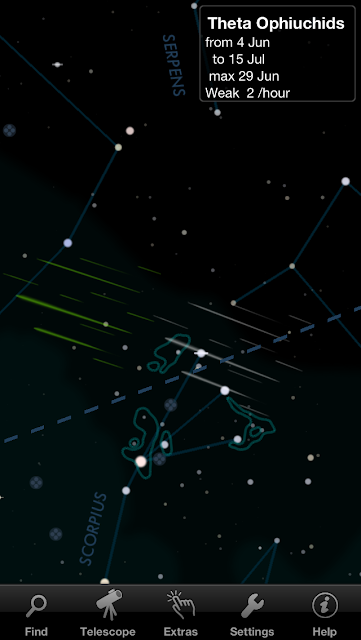
As a plus I saw a nice meteor in Scorpius (see below for the location from Skymap HD). I haven't ever really done any good watching for meteors, but since I was already pointed in that general direction I saw a really nice one during this relatively minor shower (2/hour isn't anything special so seeing one is cool).

Wednesday, March 13, 2013
Panstarrs C/2011 L4 and more
We had a great time at the Mineola Nature Preserve on 03/13/2013 looking for PanStarrs C/2011 L4 (Magnitude 1). While we were waiting I did get a shot of the moon 1 day after New (so a fingernail to be sure). Once it darkened up I tried my luck with the Double Cluster in Perseus, Horsehead Nebula in Orion and Andromeda's Galaxy
 |
| Fingernail Moon |
 |
| PanStarrs C/2011 L4 in the twilight sky |
 |
| Double Cluster in Perseus |
 |
| Flame Nebula (left) and Horsehead (right) in Orion |
 |
| My first attempt at Andromeda's Galaxy |
Saturday, January 19, 2013
Jupiter at Jon Watkins' House
Jon Watkins was nice enough to have the club out to his house again and this year we pretty much focused (get it) on Jupiter. I looked up when the red spot would transit and luckily got some shots of it while it was in view. I made a looping animation to show the movement and moons and then did some color saturation and contrast on the image I liked the best to show off the bright colors.
Shooting rig - C8 with a Meade flip mirror and Canon EOS T3 (12.2mp) - I was using EOS Capture to control the camera and record from the live view feed w/ a 5x zoom. That gives me (according to Jerry Lodriguss) a pretty much 1:1 pixel density so I'm getting as good a shot as I can get. I didn't crop at all so what you see is exactly what I got.
Looping animation of 18 frames - some are a little darker, but it's a neat effect. If you look closely at the top of the image you can see two of the moons moving in different directions (one is close and the other is far so you can see how they orbit).

Still frame of the first good shot. I bumped up the color saturation and contrast to make the colors more visible, but other than that I was just glad to get a decent shot of the red spot. Sure I'd like to have used a barlow lens, but I'm glad to at least get the opportunity and have some fun learning my rig.

Shooting rig - C8 with a Meade flip mirror and Canon EOS T3 (12.2mp) - I was using EOS Capture to control the camera and record from the live view feed w/ a 5x zoom. That gives me (according to Jerry Lodriguss) a pretty much 1:1 pixel density so I'm getting as good a shot as I can get. I didn't crop at all so what you see is exactly what I got.
Looping animation of 18 frames - some are a little darker, but it's a neat effect. If you look closely at the top of the image you can see two of the moons moving in different directions (one is close and the other is far so you can see how they orbit).

Still frame of the first good shot. I bumped up the color saturation and contrast to make the colors more visible, but other than that I was just glad to get a decent shot of the red spot. Sure I'd like to have used a barlow lens, but I'm glad to at least get the opportunity and have some fun learning my rig.

Saturday, November 3, 2012
Jupiter and Uranus
So far I'm feeling pretty good with the C8. I've gotten the collimation to a point where I'm reasonably happy with it. It's no refractor, but I'm probably spoiled now that I've gotten a taste of the clear stuff (even if it is a little purple-y). That being said I'm in love with my new flip mirror setup. It's well worth the money especially now that I've worked out the focus and can get reasonably close before flipping over to the camera. I'm sure I'll eventually get a guider, but for the time being I'm enjoying the process of learning to image planets without one. Turns out I only get about 2 min per shot of Jupiter before the planet rotation causes the features to blur.
Jupiter on a loop - I have about 7 decent frames and it's looping
back and forth so you can see some of the details.

Here it is with some levels applied to bump up the contrast.
You can't see the moons now, but the planet looks better.

Uranus - it's small and blue, but you can tell it's a planet.

Saturday, October 20, 2012
Harrison's first star party
 |
| Harrison showing his star chart to his public |
My son Harrison is a cub scout, but even if he wasn't he'd want to participate in a star party (even if just because I'm into it). Tonight we brought his 70mm scope, I equipped him with a 25mm eyepiece and turned him loose. We'd practiced aiming at the house and his red dot was sighted in (fairly well) so I told him to show the kids the moon.
We had about 200 - 300 people and at least 100 kids who absolutely had to be in his line. He talked and showed and was an ambassador of the sky for hours. He explained to them that the red light would preserve their night vision and showed them how to use star charts and identify the bright stars. He kept his scope pointed (manually) at the moon and when people said they couldn't see anything he took care of it graciously.
I could not have been prouder of my Junior Astronomer son. Kids loved talking to him (in their language) and were really excited to have a person their size who was on the staff. :)
Sunday, August 26, 2012
First Light (in the daytime) with Solar Filter

Here's my first attempt at using a Solar Filter. I purchased a glass one from Orion and even though it's really a snug fit I'm not worried that it'll fall off.
Subscribe to:
Posts (Atom)